Tacos el Premio Mayor
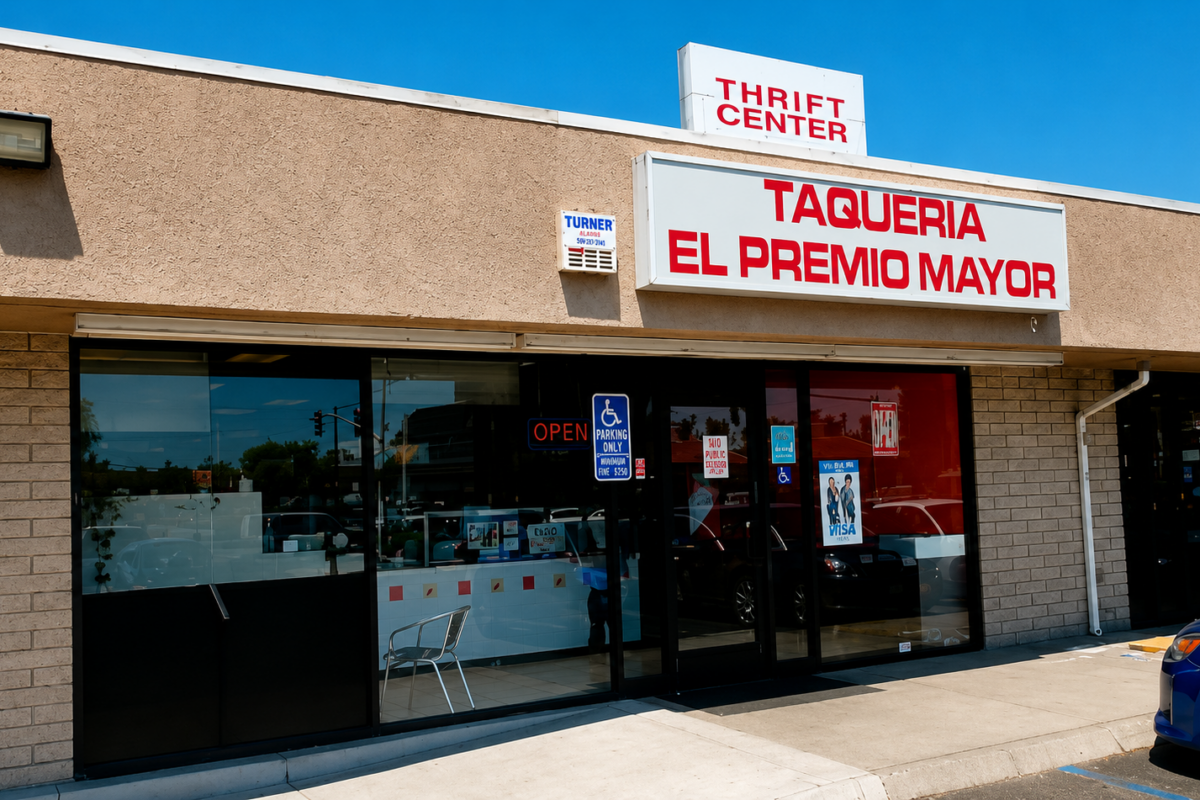
Every town has one: the cursed location, the storefront that kills whatever moves into it. Ours is at an unnamed shopping center at the intersection of Bullard and Palm Avenues, where a small coffee shop held on until sometime in the 90s, with the space now cycling through tenants the way other buildings cycle through paint colors, each new sign going up with fresh optimism and coming down eighteen months later. My wife and I have watched this happen enough times that the address itself has become a kind of running joke between us. When the newest occupant opened to relatively good reviews, it seemed like it was time to test the curse in person. Maybe this restaurant had broken it.
We were seated promptly, which was a promising start. After that? Nothing. Menus, but no water. Staff moving about with a practiced ability to see every table, except ours. Five minutes became ten. Ten became fifteen. My wife and I exchanged a look, no, the look. The one married people don’t need words for, the one that says we’re leaving and neither of us has to say it. We stood up and walked out. The curse lives on. Afterwards on the drive that followed, we did what you do when the experiment fails: you go to the control group.
Our control group sits at Maroa and Shields, a few blocks west of the Manchester Mall in a stretch of Fresno that hasn’t been called desirable in several decades. Blackstone, once the spine of the city, a commercial strip everything else grew from, now suspended in that awkward phase between its former glory and a gentrification that keeps not arriving. A rotating assortment of mini liquor bottles strewn about the parking lot, unhoused people crossing it on routes that only make sense to them. It doesn’t feel unsafe, exactly. It feels forgotten, which is a different thing, and which makes what’s inside the small building matter more.
Inside, Tacos el Premio Mayor is mostly kitchen. A few tables line the wall to your right, close enough to the cooking that the room runs a few degrees warmer than you’d expect. The flat-top heats the dining room the way a wood stove heats a cabin. The heat runs figurative, too: they’ll build your order at whatever spice level you’re brave enough to claim out loud. Above the tables, a mural runs along the wall: the family’s food truck, and over it a cartoon man, grinning, hoisting two trophies. On the left side, where once a short counter with stools stood, a sheet of clear Lexan now stands, blocking off the space and separating staff from customers, a leftover fossil of the Covid years that nobody has gotten around to removing, or maybe nobody wants to. Some scars a place just keeps.
Order the gordita-style tacos. The shell sits somewhere between a tortilla and a sope, the closest reference most people will have is the fry-bread tacos you see at the fair. The shell is expertly fried until it takes on a light sheen of oil and a fluff that a regular tortilla can’t manage. That fluff however is pulling double duty. It plays its light and fluffy texture against the dense and flavorful asada stacked on top of it, a battle of light against heavy. And it absorbs, soaking in the salsa and the meat’s own juices the way a tortilla never could, so the flavor ends up in the bread instead of running down your wrist.
There’s an engineering trade-off, a risk versus reward. The thickness that makes the shell so good also makes it stubborn. It doesn’t fold the way a proper taco would, every bite becomes a small structural negotiation. Instead of a diner you become an impromptu civil engineer, deciding where to grip, what angle, how much you’re willing to lose to the plate. Judge right and you are rewarded with a perfectly balanced bite, judge wrong and you might end up wearing a bit of your meal.
You place your order at the Lexan, and taped to it, beside the window where the food comes out, is a photograph: a young man on a baseball field at night, holding a trophy. It’s the same man from the mural.
Adrian Loza used to say he’d been working at El Premio Mayor since he was ten years old. By 2015 he was the one leading the charge when it swept the Fresno Grizzlies’ 5th Annual Taco Truck Throwdown, an annual event at the downtown stadium where the region’s taco trucks compete in front of thousands, taking home both the judges’ award and the fans’ favorite. Two trophies in a single night, it was the win that put the name in front of a Fresno that might otherwise never have ventured south of Shaw to find it.
He died on January 23, 2016, the day before his mother’s birthday. He set out for a jog wearing his usual headphones, but January rains had made his regular route muddied, forcing him to find an alternate route running on the railroad tracks. He was struck by a train. In the weeks after, the community the family had been feeding for years fed them back, raising more than $8,000 toward the funeral. The restaurant is still run the way he grew up in it, by the family, which may be the most durable kind of memorial a place like this can offer.
The rest of the menu scales to your ambition: standard tacos on regular tortillas, about $3 each, the right entry point if taqueria food is new territory for you; burritos for more substantial hunger, $11 to $14, available dry, drowned wet in sauce, or, for the committed, wrapped entirely in bacon; tortas in the same range, the Mexican sandwich, for anyone who wants these flavors in a format their hands already understand; and a corn dog, which will save you if you’ve brought small children along, but which nobody has ever driven to a taqueria hoping to find.
Trying new places is how you find a place like this in the first place, nobody inherits a favorite taqueria; somebody in your life once gambled on it. But the search has a failure rate, and some days you pay it, sitting unwatered at a table at a cursed spot while the staff perfects the art of not seeing you. What those days are for, it turns out, is reminding you what the reliable place is actually worth. You will walk into El Premio Mayor a little irritated at the day. You will leave having forgotten why. It is something like coming home, which is fitting for a restaurant that is, at every level of its operation, a family.
I’m no linguist, but “el premio mayor” translates to something like “the grand prize”, or “jackpot tacos”, depending on how confident your Spanish is feeling. In 2015, at a stadium a few miles up the road, the name became literal. It’s been accurate every visit since.